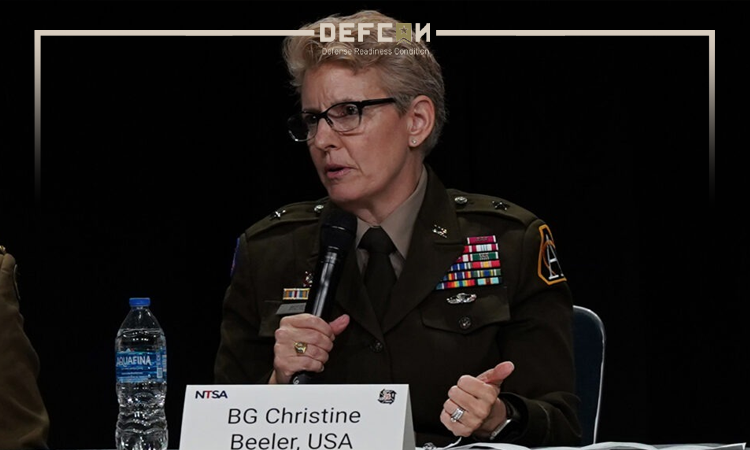
A senior US Army training and simulation official said the service’s sweeping acquisition overhaul is opening the door for faster modernization of its digital network and accelerating the transition of training capabilities to cloud-based environments. Brig. Gen.
Christine Beeler, the Capability Portfolio Executive (CPE) for Simulation, Training and Instrumentation (STRI), said legacy structures had slowed the Army’s ability to capitalize on emerging technological opportunities.
Speaking at the I/ITSEC 2025 conference in Orlando, Beeler noted that enabling simulation and threat-representation services through the cloud will allow soldiers to access training tools anywhere and from any platform, ultimately enhancing force readiness. She added that modeling and simulation work directly strengthens lethality and operational understanding.
STRI is currently undergoing an organizational shift as part of Defense Secretary Pete Hegseth’s acquisition reforms, which replace Program Executive Offices (PEOs) with new Program Acquisition Executive (PAE) offices.
The new structure merges three former PEOs—now CPEs—including STRI, Intelligence and Electronic Warfare, and Command, Control, Communications and Networks. Beeler said placing these entities under one umbrella will improve coordination, eliminate stovepipes, and minimize friction across programs.
The broader restructuring aims to reduce the number of entities dictating requirements and speed up capability delivery to warfighters, according to Army leaders.
With more flexible funding mechanisms expected, STRI hopes to advance its goal of fully transitioning training and simulation platforms to the cloud, enabling widespread and rapid access.
Beeler said 2026 will focus on addressing transitional challenges, with tangible results expected by 2027, particularly in cloud transformation. She emphasized that training systems, though less “glamorous” than major weapons programs, are foundational to mission success.
“We simulate the fight, we replicate the threat so we can win across all domains,” Beeler said.