
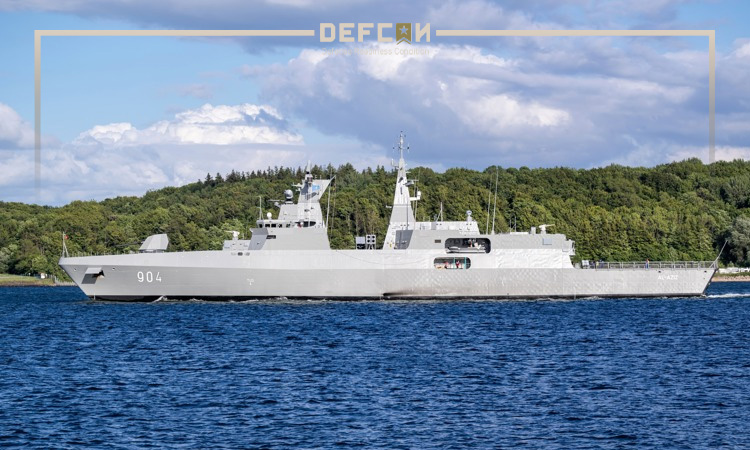
The USS Ted Stevens DDG 128, constructed by Huntington Ingalls Industries at its Pascagoula shipyard, has successfully completed acceptance trials in the Gulf of Mexico, demonstrating its propulsion, navigation, combat systems integration, and overall seaworthiness. On November 21, 2025, the US Navy’s Board of Inspection and Survey confirmed that the ship fully meets the Navy’s stringent delivery requirements.
USS Ted Stevens is the second Arleigh Burke-class Flight III destroyer to reach this milestone, representing the most technologically advanced configuration in the class. Flight III is designed to counter evolving aerial and missile threats, providing integrated air and missile defense capabilities across contested maritime theaters.
At the core of Flight III upgrades is the AN/SPY-6(V)1 air and missile defense radar developed by Raytheon, featuring gallium nitride (GaN) technology that provides over 30 times the sensitivity of the SPY-1D(V) radar it replaces. The radar significantly improves detection, tracking, and discrimination of modern threats, including low-observable cruise missiles, maneuverable ballistic missiles, and hypersonic weapons, and is fully integrated with the Aegis Baseline 10 combat system for simultaneous defense against air, surface, and subsurface threats.
Flight III also features extensive mechanical and electrical redesigns, including enhanced power generation and distribution, upgraded cooling and HVAC systems, and modified superstructures to optimize high-power radar performance and electromagnetic compatibility. While retaining the same hull form, Flight III represents a quantum leap in combat and electro-technical capabilities.
During acceptance trials, Navy inspectors evaluated the propulsion, navigation, damage control, communications, and weapons integration systems, including live-fire tests in simulated combat scenarios. The results confirmed that DDG 128 meets all contractual specifications, paving the way for its final outfitting and entry into service, expected in 2026.
The ship is named in honor of the late U.S. Senator from Alaska, Ted Stevens, a strong advocate for defense modernization. The Arleigh Burke class remains the largest surface combatant class in U.S. Navy history, with 74 ships currently in active service as of November 2025, and Flight III variants expected to serve into the 2070s.
Huntington Ingalls has delivered 35 Arleigh Burke-class destroyers to date and is currently constructing five additional Flight III ships: Jeremiah Denton (DDG 129), George M. Neal (DDG 131), Sam Nunn (DDG 133), Thad Cochran (DDG 135), all equipped with SPY-6 radar and Aegis Baseline 10 systems.
The addition of Flight III ships, including USS Ted Stevens, enhances the U.S. Navy’s deterrence and combat capabilities in high-tension regions such as the Western Pacific, Eastern Mediterranean, and High North, providing advanced radar coverage, coordinated fire control, and layered missile defense to maintain U.S. maritime superiority against emerging threats.


