After the U.S. Army decided this summer to cancel its long-range jamming programs for both air and ground platforms, electronic warfare leaders presented their new vision for 2026, which includes an alternative aerial program and a rapid push toward a new model of ground-based EW capabilities, according to Brig. Gen. Kevin Chaney and his team during a press briefing.
Chaney, the newly designated Capability Program Executive for Intelligence, Electronic Warfare, and Sensors, said that 2026 will mark a new start that builds on the MFEW-Air Large program, which had been under development for more than a decade. He acknowledged that the original program faced significant challenges due to an outdated “monolithic acquisition approach,” emphasizing that the new effort will rely on flexibility and openness to commercial technologies, following an incremental strategy and modular designs that allow repeated, rapid updates in line with evolving threats and technologies.
“We’ll move into experimentation in 2026 to see what capabilities are available and how we can rapidly integrate them into different designs,” he added.
The new strategy reflects a growing trend within the Pentagon toward open-architecture systems that make component replacement easier and allow systems to be disaggregated into smaller units that can be deployed to remote regions such as Pacific island chains while being harder to target in complex theaters like Ukraine.
Laurence Mixon, Chaney’s civilian deputy, explained: “We’re looking at separating soldiers from the apertures and emitters to increase survivability, because once you emit, you become a target on the modern battlefield. We are also exploring methods of delivering effects that rely less on raw power and more on technique.”
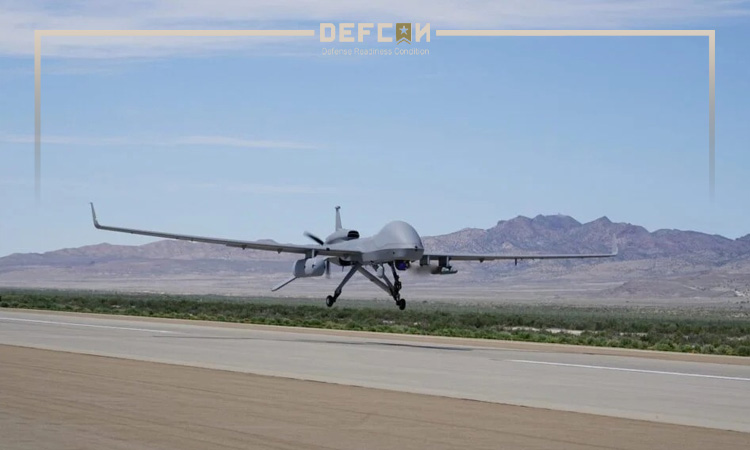
The original MFEW-Air plan centered on a large jamming pod mounted on the heavy Gray Eagle drone, while the TLS-EAB ground system required multiple heavy trucks, making deployment difficult and creating large, vulnerable targets. The new vision moves toward a combination of free-flying and tethered drones, ground antennas, and human operators that can be physically separated to reduce the risk of losing an entire system to a single strike.
Regarding the new ground-based system, Col. Scott Shaffer, the project manager, said: “We are currently exploring several variants, from extended-range antennas to the use of tethered drones.” Tethered drones can draw power and transmit data through a cable connected to a ground vehicle, making them smaller, cheaper, and harder to detect—though with limited mobility.
Shaffer emphasized the importance of integrating these systems with the Army’s emerging family of Launched Effects—mini-drones fired from helicopters or ground vehicles and capable of carrying different payloads.
He added that flexibility and openness to commercial technology remain central: “We’ll be engaging with industry to integrate processing equipment, antennas, modular components, transit cases, and more, trying to make everything as small as possible to fit whatever platform the Army chooses. Our goal is to move quickly into prototyping over the next year or two.”
Shaffer noted that the new ground-based system will not resemble the old multi-truck TLS-EAB model: “We spent a lot of time and money on it over three years, but it became very expensive and encountered challenges, so we decided to pivot.”
Chaney also stressed that the new approach differs sharply from the massive Soviet-era EW platforms used effectively by Russia in the early stages of the Ukraine conflict: “Russia can afford to deploy large platforms and move them across land to nearby battlefields. For us, we must consider not only Europe but INDOPACOM as well, so we need more modular and transportable designs.”
The shift signals a major transformation in U.S. electronic warfare doctrine—toward lighter, more distributed, and rapidly upgradable systems designed for highly contested environments marked by dense jamming and fast-evolving threats.