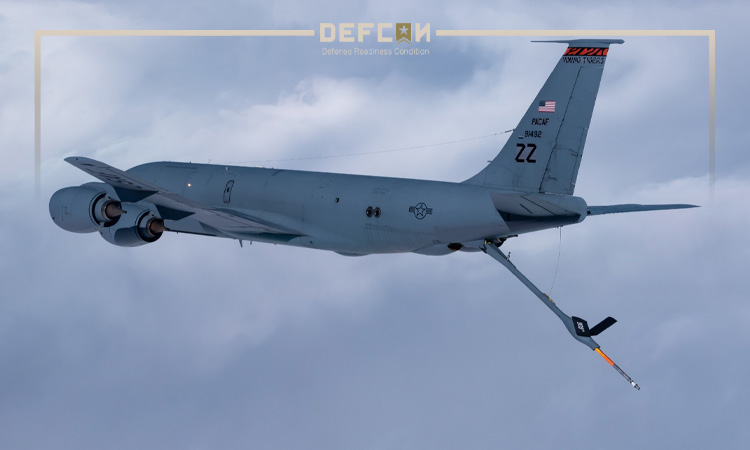
High Value Airborne Assets (HVAA) — such as KC‑46 and KC‑135 aerial refueling tankers, and tactical airlift platforms like the C‑17, C‑130, and C‑5 — are critical enablers of airpower projection, war‑time logistics, and adversary airspace monitoring. These platforms form the backbone of strategic reach, allowing tactical fighter aircraft to operate effectively far beyond forward‑deployed bases.
Traditionally, these aircraft operated outside the Weapon Engagement Zone (WEZ), but they have increasingly become vulnerable targets due to the rapid evolution of long‑range surface‑to‑air and air‑to‑air missiles, as well as multimodal electronic warfare attacks. This shift is forcing militaries to upgrade their survivability suites and adopt more advanced defensive capabilities.
According to BAE Systems experts Jared Belinsky, Product Line Director for Integrated Survivability Solutions, and Avetis Ioannisyan, Strategic Air Program Director, the inherent characteristics of these platforms heighten their exposure: their large size, relatively slow speed, and significant electromagnetic signatures make them easier to detect by sophisticated adversary sensors. Many of these aircraft also originate from older commercial designs that were never engineered for reduced radar visibility.
With growing threats from peer competitors such as China and Russia — armed with advanced, long‑range weapon systems — tankers and airlift aircraft are increasingly forced to operate in contested airspace. This reality demands the adoption of layered electronic protection tactics and multi‑domain survivability solutions. These include RF countermeasures, expendable and towed decoys, and the deployment of specialized electronic warfare aircraft to sanitize key air corridors.
Ioannisyan notes that modern threats have become multimodal, capable of switching across frequency bands, fusing sensors, and leveraging third‑party targeting. This requires integrated defensive networks designed to counter advanced seekers and long‑range missile systems. Beyond electronic attacks, long‑range surface‑to‑air and air‑to‑air missiles now pose a direct threat that restricts the traditional operating envelope of HVAA platforms.
Integrating advanced defensive systems into these aircraft presents significant engineering challenges — particularly on tankers such as the KC‑135, which lack wing stations for mounting external pods. As a result, defense engineers must work within the limited real estate of each airframe, embedding countermeasures and decoys strategically to preserve maximum survivability.
An ideal protection architecture relies on multiple layers: long‑range missile‑plume sensors, radar‑warning receivers, RF jammers, towed or expendable decoys, and kinetic intercept options — all operating together to keep these high‑value assets mission‑capable in contested environments. By combining electronic warfare, kinetic defense, and tactical deconfliction, HVAAs can continue enabling fighter aircraft and delivering critical logistics to the right place at the right time, ensuring sustained U.S. air dominance.
In today’s threat environment, protecting High Value Airborne Assets has become a strategic imperative — blending advanced technology, tactical planning, and multi‑domain defense to counter increasingly sophisticated adversaries. Preserving the readiness of these platforms is essential for maintaining global airpower projection and freedom of maneuver in contested theaters.